
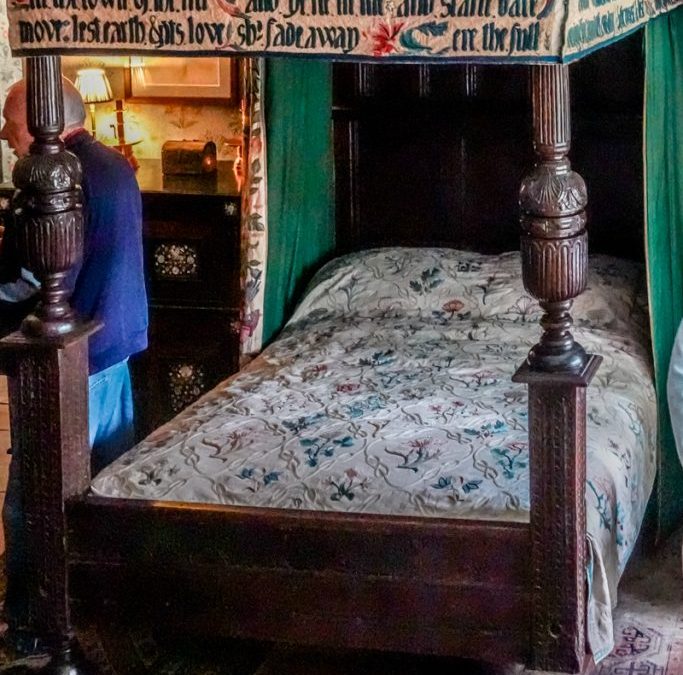
The Arts and Crafts Movement emerged in Britain in the late nineteenth century, at a moment when the world was changing very quickly. Factories were humming, cities were swelling, and objects once made individually by skilled hands were increasingly being produced by machine.
Not everyone was convinced this represented unqualified progress.
William Morris, John Ruskin and others began asking uncomfortable questions about what might be lost when making became manufacturing. What happened to craftsmanship when the person making an object performed only one small part of the process? What happened to beauty when speed and price became paramount? And what happened to the worker when skill gave way to repetition?
Their concerns helped give rise to the Arts and Crafts Movement.
A Philosophy Rooted in Work
John Ruskin supplied much of the intellectual foundation. He believed the conditions under which things were made mattered as much as the finished objects themselves. William Morris took those ideas and ran with them—with considerable energy.
Morris admired medieval craftsmanship and the guild tradition, where a skilled worker might have much greater involvement in making a complete object. He objected to the separation of designer from maker and to industrial processes that reduced skilled work to repetitive tasks.
There was something important in that critique. But it is also very easy to romanticize the world industrialization displaced.
Work had always been hard for most people, frequently brutally so. Agricultural labour, mining, domestic service, workshops and home-based trades involved long hours, physical danger and economic insecurity. Children worked alongside adults long before factories appeared. The factory did not pluck them from an idyllic childhood.
Industrialization concentrated labour on an unprecedented scale and produced horrors of its own, particularly in its early decades. But it didn’t invent arduous work.
Which raises another question alongside Morris’s: What did industrialization give us?
The Complication of Craftsmanship
I have some sympathy with Morris’s insistence on understanding how things are made.
My father held similarly robust views about doing things properly, which meant I spent portions of my youth wire-brushing old beams before they could be treated with linseed oil, removing rust from cast-iron radiators and pulling nails from reclaimed hardwood. Along the way, I learned to plaster, feather seams, lay tile and tackle simple wiring.
I emerged with a lasting appreciation for craftsmanship—and an equally lasting understanding of why the Industrial Revolution caught on.
Making things properly by hand takes time. Skilled time costs money. And therein lay one of the great contradictions of Arts and Crafts.
Morris wanted beautiful, well-made objects to enrich ordinary life, yet the labour required to produce them made many Morris & Co. goods expensive. The machine he distrusted was also capable of putting furniture, textiles, china and innumerable other household goods within reach of people who could never have afforded individually handcrafted versions.
Arts and Crafts never entirely resolved that contradiction. Perhaps it couldn’t. But it asked a question that remains worth asking: when does efficiency improve our lives, and when does it diminish something we value?
So What Does Arts and Crafts Look Like?
There isn’t one Arts and Crafts look. The movement gave us everything from relatively restrained architecture and sturdy furniture to William Morris’s exuberantly patterned wallpapers and textiles.
Certain characteristics do appear repeatedly: natural materials such as wood, wool, clay and stone; sound construction; good proportions; evidence of the hand and skill of the maker; and decoration inspired by leaves, flowers, birds and other natural forms.
Sometimes the result is spare; other times it decidedly isn’t. No one could accuse Strawberry Thief of excessive reticence.
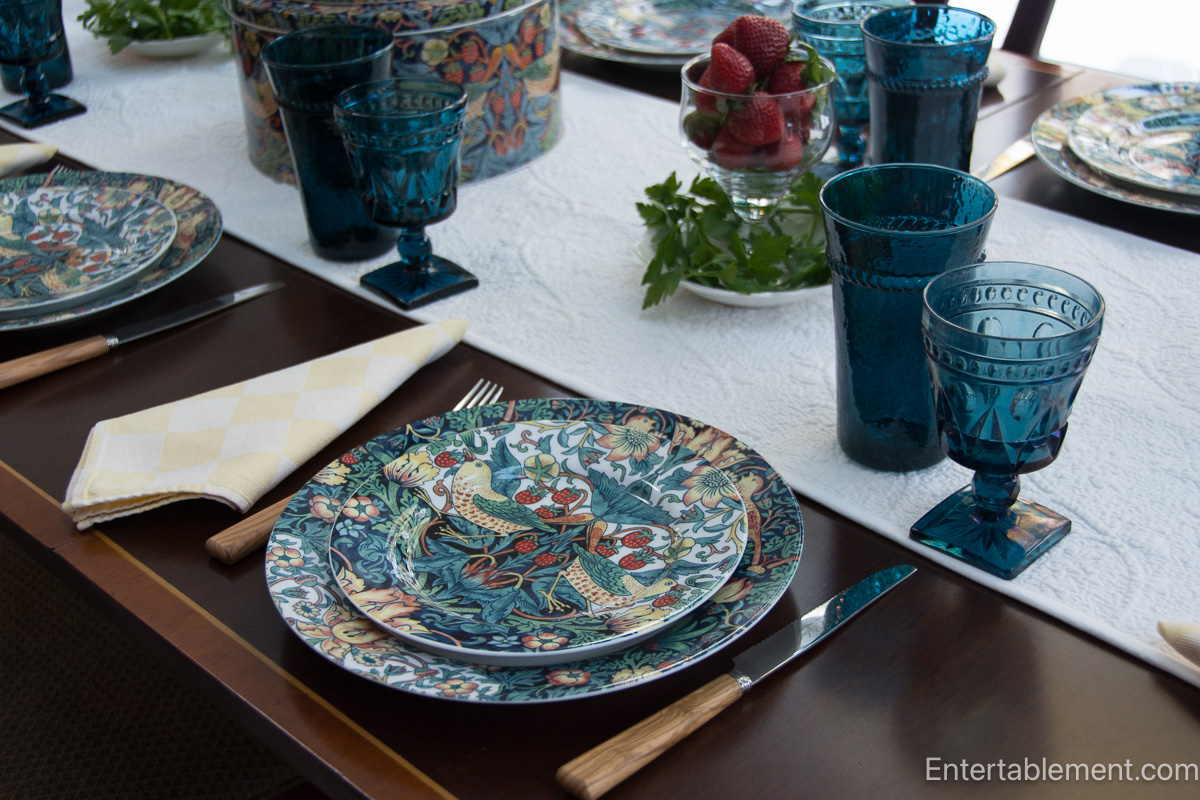
What connects these very different expressions is less a particular decorative style than an attitude towards making. Materials were allowed to look like themselves. Construction wasn’t something to be ashamed of. Craftsmanship remained visible.
And useful things could also be beautiful.
The People Behind the Magic
William Morris inevitably dominates the story. He was a designer, poet, businessman, publisher, political activist and apparently a man with enough energy for several ordinary mortals.
Through Morris & Co., he and his collaborators produced textiles, wallpapers, furniture, embroidery, stained glass and other decorative arts whose influence continues today. But Morris & Co. was never simply William Morris.
Philip Webb translated many of the same ideas into architecture. Edward Burne-Jones worked extensively in stained glass and decorative art. John Henry Dearle became an important designer for the firm. William De Morgan brought his extraordinary ceramics into the wider Arts and Crafts world. And then there was Morris’s younger daughter, May.
May Morris deserves considerably more than a footnote to her famous father. An accomplished designer and embroiderer, she took charge of Morris & Co.’s embroidery department in 1885, when she was only twenty-three. She designed textiles, wallpaper and jewellery, taught and lectured, wrote about embroidery and later founded the Women’s Guild of Arts.
We’ve just encountered one of her designs here on Entertablement. The Seasons by May linens used on our recent William Morris Autumn Table are based on Spring and Summer, an embroidery dating from about 1895, designed—and most likely stitched—by May Morris. Its parakeets, stylized roses, tulips and curling foliage are unmistakably part of the Morris world.

But they’re May’s. That distinction is worth making.
When a Philosophy Becomes a House
Architecture may be one of the easiest ways to explore what these ideas meant in practice.
Philip Webb’s Red House, designed for Morris and completed in 1860, is one of the seminal buildings in the development of Arts and Crafts. Rather than imposing a fashionable architectural formula, Webb and Morris thought about materials, setting, craftsmanship and how the people inside would actually live.
A few decades later, Webb designed Standen in West Sussex for James and Margaret Beale.
Standen fascinates me because it complicates any idea that Arts and Crafts simply meant turning one’s back on modernity. Completed in the 1890s, the house incorporated local materials and traditional craftsmanship, and Morris & Co. supplied wallpapers and textiles. It also had electricity and central heating. Quite right, too.
The point wasn’t—or needn’t have been—to recreate the Middle Ages. It was possible to retain craftsmanship, good materials and a sense of place while cheerfully accepting innovations that made life more comfortable.
The National Trust now looks after Standen and, rather dangerously, has a holiday apartment there. I’ve spotted it. Research may be required. 🙂
When the Ideas Escape the Movement
I’ve been thinking about all this since our recent stay at Moor View in the village of Edensor (pronounced “Enzer” – they drop the “d”).

Which is directly across from Chatsworth..

Moor View was built in the 1920s as a Dower House and designed by Romaine-Walker, so it belongs to a later generation than Webb and Morris. It’s described as a “late” Arts and Crafts house, and I kept noticing things that felt familiar, such as simple painted panelling, built-in cupboards and bookshelves.
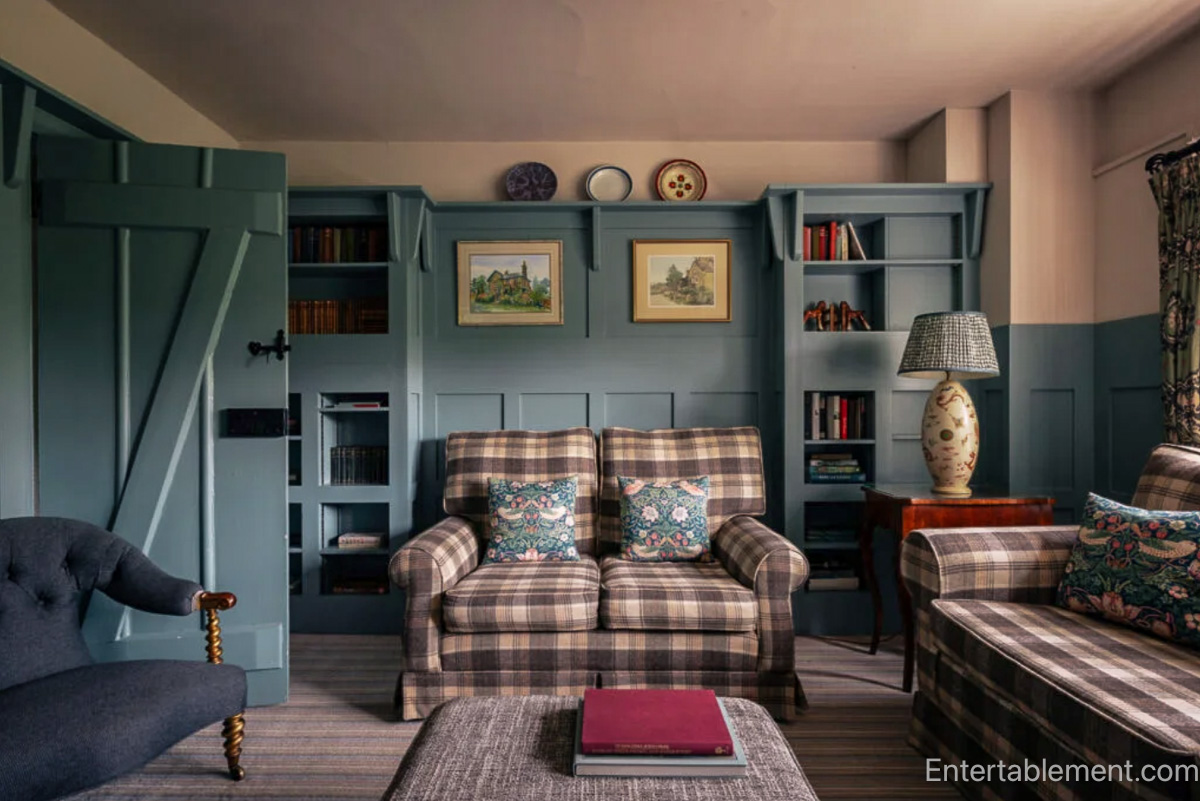
A gently curving staircase rail providing interest without elaborate applied ornament.
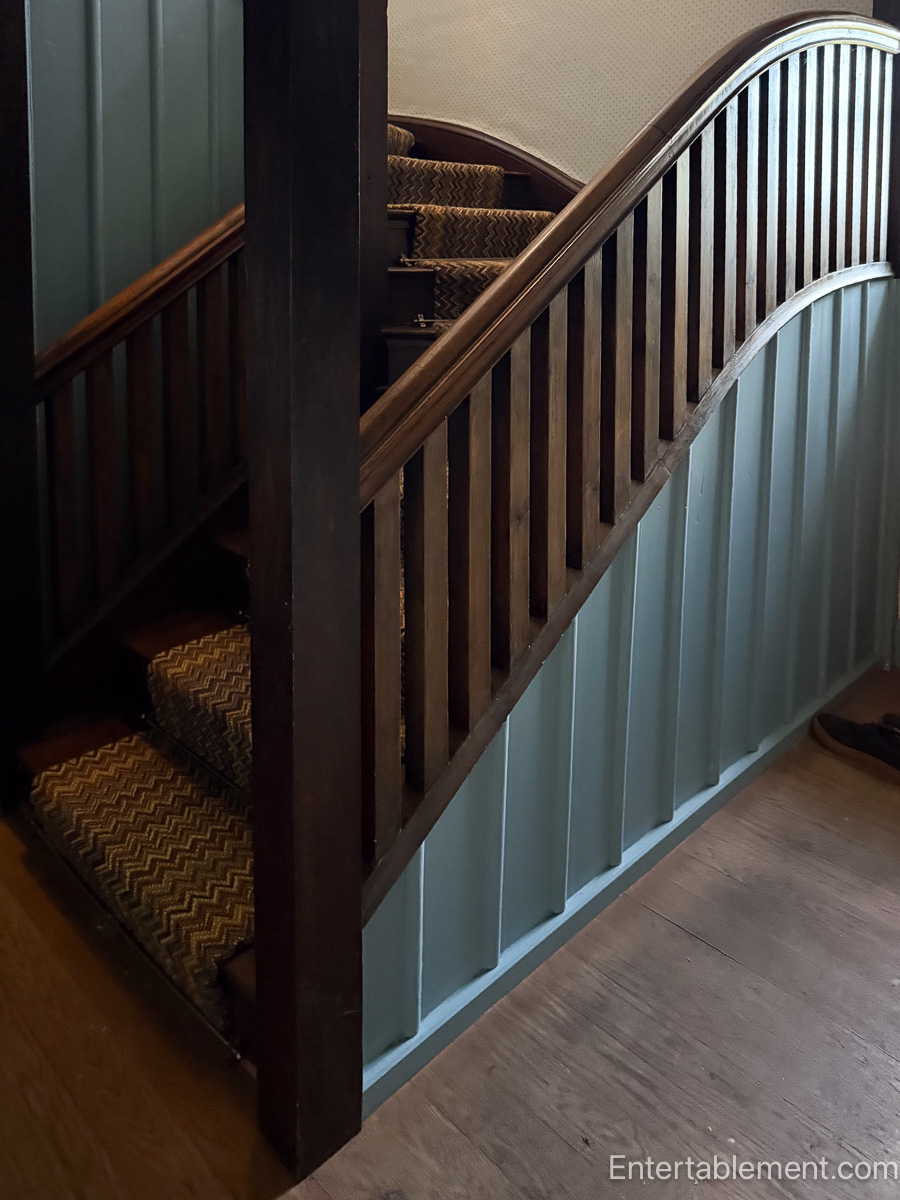
Awkward spaces put to useful work. Rooms designed around comfortable domestic life. The primary bedroom ensuite was to die for.

It made me wonder whether this is what happens when a movement succeeds: its ideas escape.
By the 1920s, elements of the Arts and Crafts vocabulary had been circulating through English domestic architecture for decades. They could be borrowed, softened and combined with other influences without anyone needing to issue a manifesto about it. Eventually, we stop noticing where ideas came from.
Across the Atlantic
The ideas travelled remarkably well. In the United States, Gustav Stickley became one of the leading proponents of an American interpretation of Arts and Crafts. His furniture emphasized straightforward construction, good materials and visible joinery, while his influential magazine The Craftsman helped spread those ideas into American homes.
Then things become even more interesting. Frank Lloyd Wright shared several Arts and Crafts concerns: natural materials, integrated interiors, craftsmanship and the relationship between a building and its setting. His Prairie houses took those ideas somewhere distinctly new.
Wright was also far more willing than Morris to make peace with the machine. And perhaps that’s where the legacy becomes more useful than trying to draw a neat stylistic family tree from Arts and Crafts through Art Nouveau, the Bauhaus and modernism.
Later designers didn’t need to accept Morris’s entire prescription. They could keep the questions: What should materials be allowed to do? How should a building relate to its setting? Should furniture, textiles and architecture be designed as parts of a whole? Can objects intended for everyday use also be beautiful? And what work should machines do for us?
A New Era of Morris
Meanwhile, Morris & Co. is still going.
Designers continue to explore its extraordinary archive, bringing unfinished and previously unpublished patterns into production and reinterpreting older designs in new colours. I rather enjoy seeing the old patterns loosen their collars a little.
The original Morris writings can occasionally have a whiff of The Four Yorkshiremen about them—all lofty ideals, privation and moral certainty. At times, one gets perilously close to the design equivalent of a hair shirt.
And I say that as someone who loves the rich patterns. I also can’t help thinking that living with William Morris himself might have had me reaching for a blunt object. Strong convictions are marvellous things. They can also create a tremendous amount of work for everyone in the immediate vicinity.
My father taught me that.
But we don’t have to accept Morris’s entire nineteenth-century programme to appreciate what he and the people around him accomplished. We can admire the craftsmanship, question the economics, enjoy the glorious patterns—and retain our central heating. That seems a reasonable bargain.
Perhaps that’s why I keep coming back to Arts and Crafts. It doesn’t offer a tidy answer to the problems created by industrialisation. In some respects, its proposed solutions created problems of their own.
But the questions were good ones.
- What do we lose when machines replace skilled hands?
- What do we gain?
- And when is something worth making slowly, carefully and well?
They are questions with a distinctly contemporary ring. As artificial intelligence begins to reshape work once again, we find ourselves debating many of the same things: what should we happily hand over to machines, what do we want to preserve for ourselves, and how might new tools extend human skill rather than simply replace it?
More than a century later, we’re still working out the answers.



I enjoy all of your posts, Helen, but this one is perhaps one of my favorites. I always learn something when I read what you write while enjoying the incredible photography of what you have beautifully created. This post reminds us that we don’t always have to neatly resolve complex and, at times, contradictory constructs, and it also reminds us to seek understanding of what has come before us and build on it. Thanks for creating and sharing this post.
I am so glad you enjoyed the post, Gordon. Researching Arts & Crafts and its players, enjoying the designs. and uncovering the variety of convictions and opinions reminds me a lot of the work we do every day. It’s complicated, and it’s also very simple. What else is possible? 🙂