
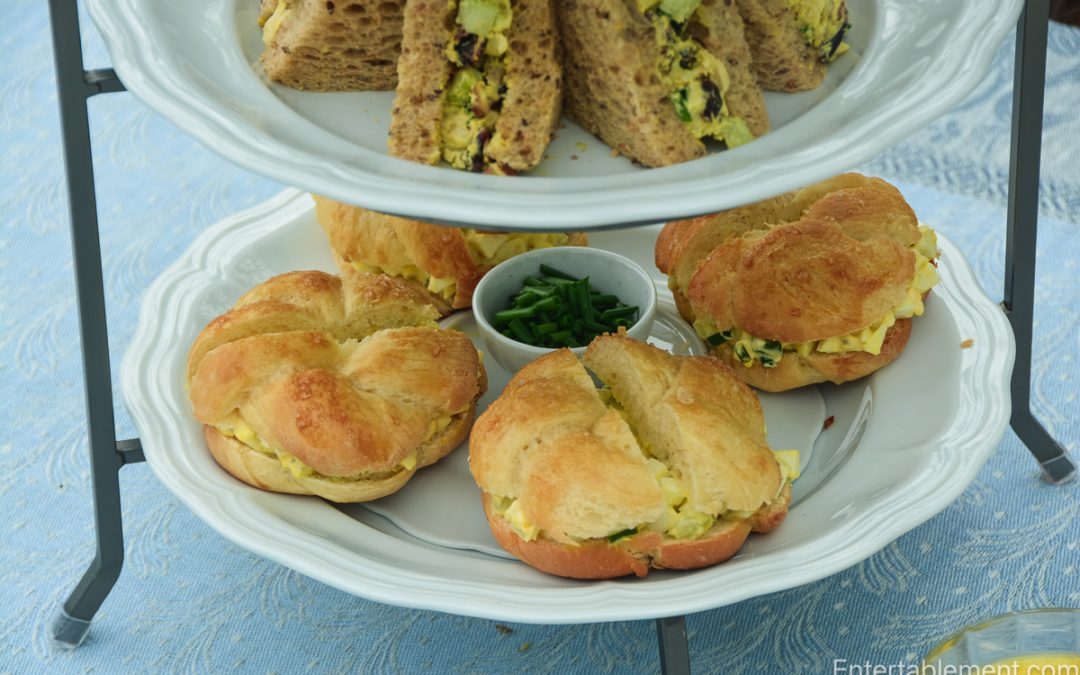
There is something wonderfully reassuring about a proper egg salad sandwich. Soft, nostalgic, and deeply civilized, these are the sort of sandwiches that belong at spring luncheons, afternoon teas, and kitchen tables where conversation tends to linger pleasantly.
The combination of creamy eggs, sharp Dijon, crisp celery, and fresh chives strikes exactly the right balance between comfort and freshness. I served the egg salad sandwiches on Lemon Knot Rolls inspired by King Arthur Baking’s wonderfully cheerful Lemon Love Buns recipe, which I shaped into knots rather than traditional rolls.

Egg Salad Sandwiches
- Yield: Serves 4
Ingredients
Scale
- 6 large eggs
- 15 ml or 1 tbsp full-fat mayonnaise
- 15 ml or 1 tbsp yoghurt, preferably Greek
- 10 ml or 2 tsp Dijon mustard
- 1 ml or ¼ tsp salt
- freshly ground black pepper, to taste
- 60 g or ½ cup finely chopped celery (about 1 stalk)
- 15 g or ¼ cup chopped chives
- 8 Lemon Knot Rolls (see King Arthur website recipe) or 6 slices multigrain bread
Instructions
- Place the eggs in a medium saucepan and cover with cold water. Bring to a gentle boil over medium heat. Remove the pot from the heat, cover, and let stand for 10 minutes.
- Transfer the eggs to an ice water bath and let cool for 5 minutes. Peel and roughly chop the eggs.
- In a medium bowl, combine the mayonnaise, yoghurt, Dijon mustard, salt, and several grinds of black pepper.
- Fold in the chopped eggs, celery, and chives. Taste and adjust the seasoning as needed.
- Spoon onto Lemon Knot Rolls or multigrain bread and cut as desired.
Notes
For the Lemon Knot Rolls, I adapted King Arthur Baking’s Lemon Love Buns recipe, shaping the dough into knots rather than standard rolls.